
An international group led by the Instituto de Recursos Naturales y Agrobiología de Sevilla (IRNAS-CSIC), together with the European Space Agency (ESA) and NASA, has succeeded in identifying microorganisms present inside volcanic caves in Lanzarote using portable technology. This breakthrough enabled direct on-site (“in situ”) analysis, without requiring samples to be sent to external laboratories.
The Junta de Andalucía reported that this technique opens the possibility of carrying out similar studies on planets with comparable environments, such as Mars, thus avoiding the need to bring samples back to Earth. The findings support the hypothesis that lava tubes on Mars could have served as refuges for life, offering protection from radiation and more stable conditions than the Martian surface.
Microorganisms adapted to extreme conditions
The research also confirms that these natural tunnels function as laboratories for designing methods to search for extraterrestrial life. Inside them, scientists analyzed the types of microorganisms that develop in these extreme environments and how they influence the minerals present.
The study included organisms that depend on organic matter, such as remains of living beings or derived compounds, and others that can survive without it. “We have also identified traces of others that are no longer present, preserved in the rocks like fossils. This allows us to detect signs of past life, both here and on other planets,” explained Ana Zélia Miller, a researcher at IRNAS-CSIC, to the Descubre Foundation Fundación Descubre.
Real-time identification and biosignatures in rocks
The results show microbial communities that adapt depending on available nutrients. Near the cave entrance, where organic matter from outside is present, biological activity is higher and microorganisms that decompose these compounds dominate. In deeper zones, where gypsum is abundant and resources are scarce, organisms that obtain energy from inorganic sources—such as minerals and carbon dioxide—prevail, in turn generating organic matter for other microorganisms.
These microbes show remarkable salt tolerance, a rare trait that helps them survive in harsh environments. During the study in the La Corona volcanic tube in Lanzarote, mineral deposits and visible biofilms were collected—communities covered by a protective layer. Some contained green photosynthetic microorganisms such as cyanobacteria or microalgae.
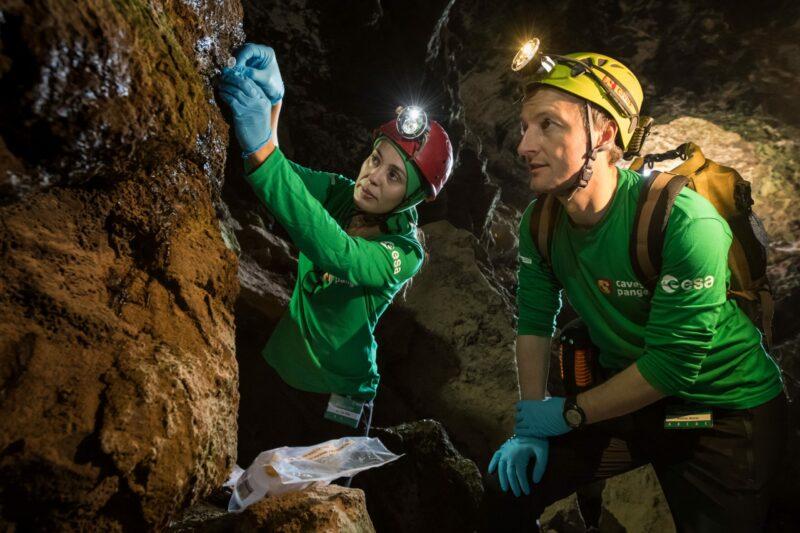
Using a portable sequencer, similar in size to a mobile phone and connected to a laptop, researchers analyzed the DNA of these samples in real time inside the cave itself, identifying halotolerant bacteria, organisms that degrade organic matter, and species adapted to nutrient scarcity.
In addition to detecting living microorganisms, biosignatures were also observed—physical and chemical traces of biological activity on rocks, such as small perforations caused by cells or metabolic byproducts that can persist for thousands of years. “These caves function as a natural archive preserving evidence of past and present biological activity. These traces are of great interest in the search for extraterrestrial life, since it is not always possible to detect living organisms, but it is possible to detect the marks they leave in their environment,” said Ana Zélia Miller.
Applications for planetary exploration and space collaboration
Researchers from the Biogeocom group demonstrate that these underground habitats not only host life in extreme conditions but also preserve records of biological activity over long periods. For this reason, they are key targets for future space missions that simulate real conditions without a laboratory, within the ESA Pangaea-X Program, dedicated to training astronauts and testing technologies for exploring other planets.
ESA astronaut Matthias Maurer participated in this mission to evaluate scientific protocols in a Mars-analogue environment. After specific training, he carried out experiments inside the cave, demonstrating that astronauts can conduct advanced research directly in the field.
The project was funded by the Andalusian Regional Ministry of Universities, Research and Innovation through Microlava (Proyexcel_00185), as well as by the Spanish Ministry of Science, Innovation and Universities, the Spanish National Research Council (CSIC), the Foundation for Science and Technology of Portugal through Microceno, and the ESA Pangaea-X program.
Source: Andalucía Información