

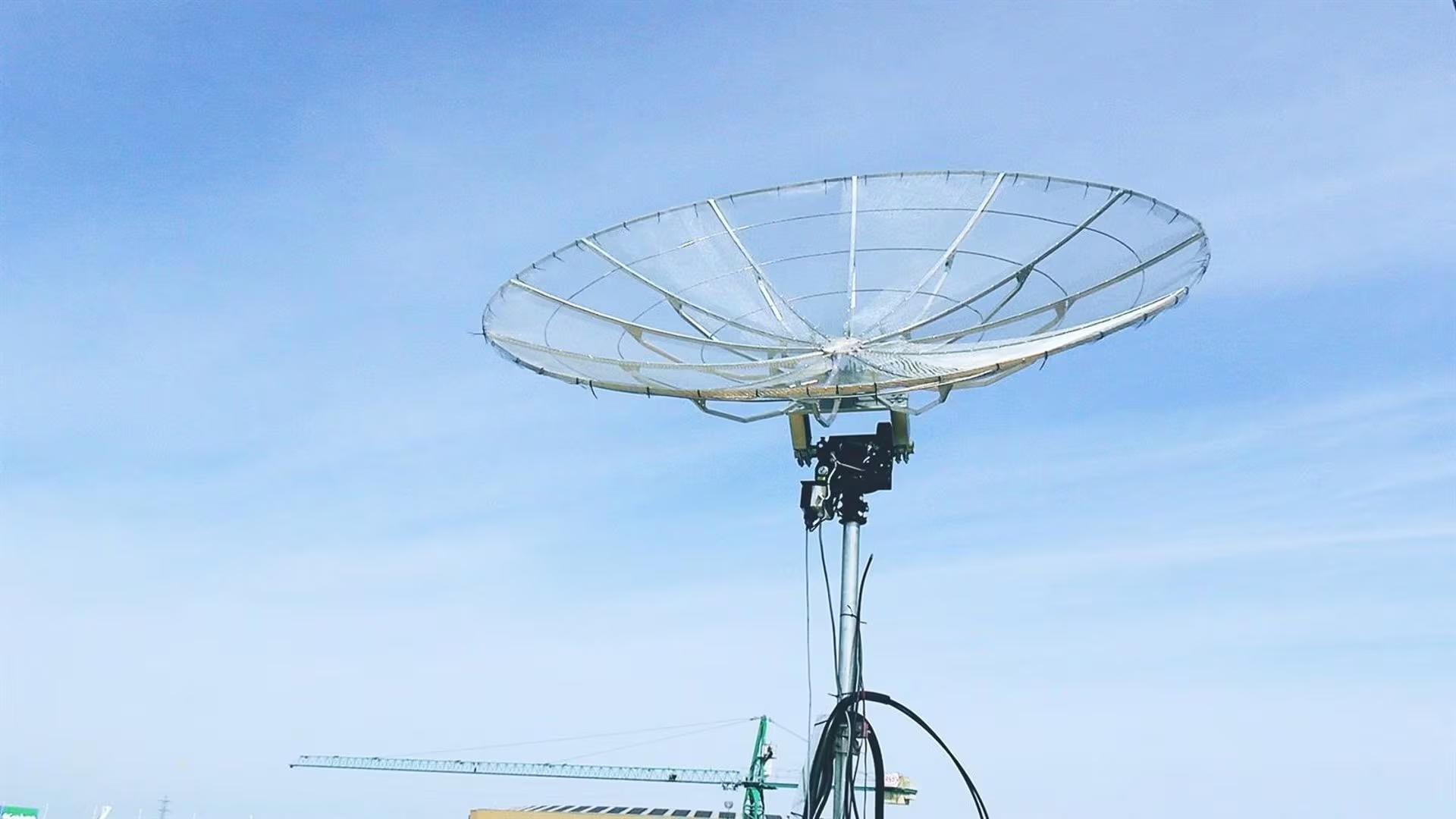
The Higher Technical School of Engineering at the University of Seville (ETSi) has been selected as the only Spanish tracking site for the Artemis II mission of the United States’ National Aeronautics and Space Administration (NASA). The tracking work is being carried out in collaboration with the Spanish company Integrasys, specialized in communications and space tracking systems.
ETSi thus joins a list of 34 participants worldwide, including government entities such as the Canadian Space Agency (CSA) and the German Aerospace Center (DLR), commercial companies like Telespazio and Intuitive Machines, as well as research and university centers. They will monitor humanity’s return to lunar orbit, according to the University of Seville (US) in a statement.
On the roof of the school, a 2.5-meter-tall Orbisat platform has been installed, developed by Integrasys’ Luxembourg subsidiary. This is a space tracking system that monitors the trajectory of spacecraft both at launch and during subsequent operations.
Using this platform, ETSi will receive, process, and transmit real-time data to NASA for analysis, helping the agency better assess the tracking capabilities of the aerospace community in general and identify ways to enhance support for future space missions to the Moon and Mars.
Based on the information received at ETSi, Integrasys will track the spacecraft’s signal and also measure the Doppler effect, a key parameter used to determine the vehicle’s position, calculate its trajectory, and provide this data directly to NASA. This project is the first collaboration between Integrasys and NASA and adds to the company’s longstanding work with the U.S. Space Force and Space Command.
Source: La Razón