
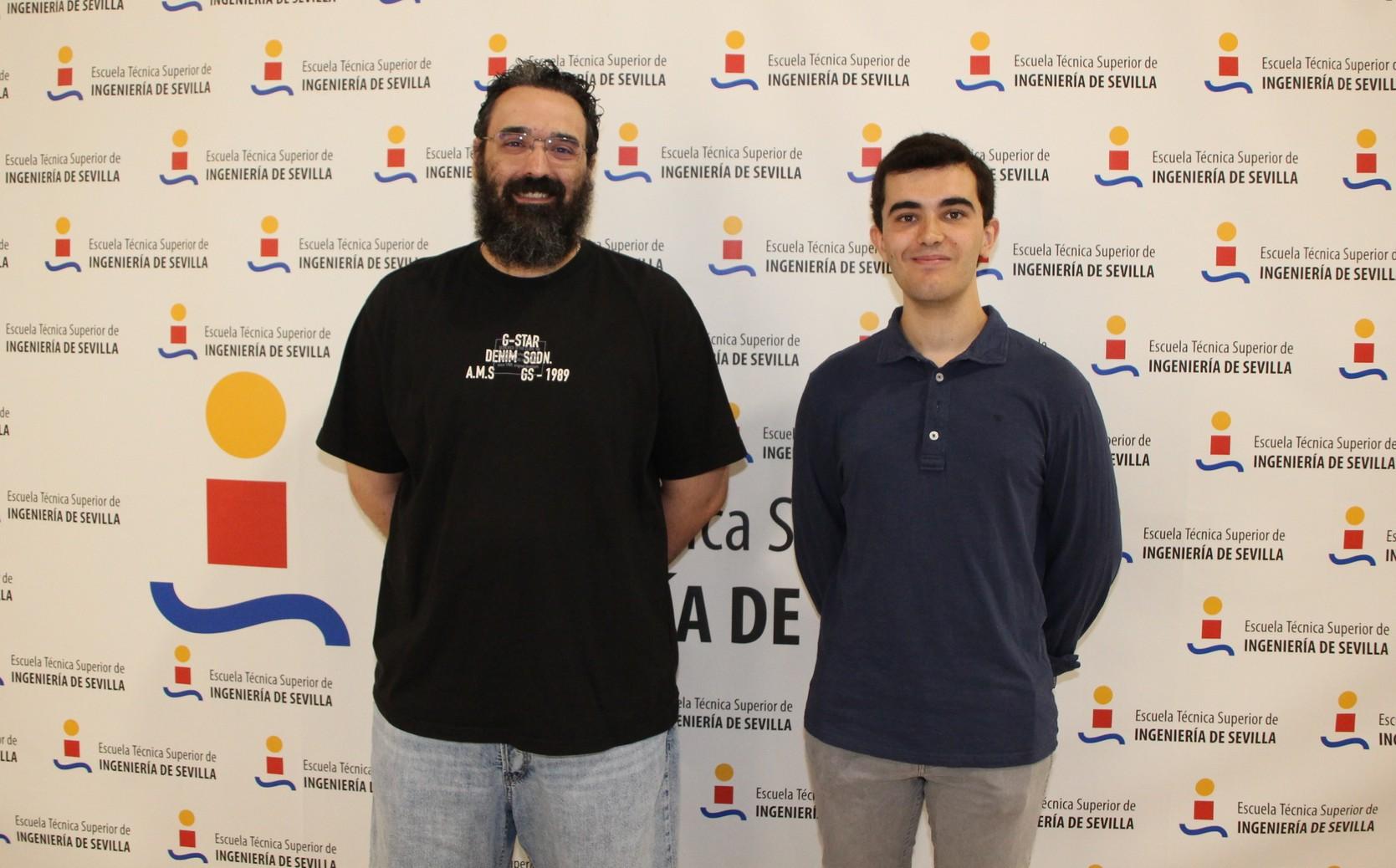
The Final Year Project (TFG) entitled ‘Implementation of a Flight Termination System module for CubeSats’, carried out by Álvaro Hanekan Gómez, a student on the Bachelor’s Degree in Industrial Technology Engineering at the Higher Technical School of Engineering, University of Seville has been selected to take part in the New Space Spain 2026 Conference, to be held in Vigo on 24 and 25 September.
The project, developed in the Department of Electronic Engineering under the supervision of lecturers José María Hinojo Montero and Fernando Muñoz Chavero, forms part of the 2030 mission of FyCUS, a student association at the University of Seville dedicated to the development of space technology.
The final-year project focuses on the design and implementation from scratch of a Flight Termination System (FTS) for CubeSats, a technology aimed at ensuring the controlled separation of a space vehicle from its launch system. In the case of FyCUS’s 2030 mission, the CubeSat will be deployed from helium balloons, and the system developed enables the activation of a burn-wire mechanism capable of melting the TX4 payload line to effect this separation.
The project forms part of a mission aimed at validating, in orbit, the use of an ABET (Air-Breathing Electric Thruster), a space propulsion technology that utilises gases from the residual atmosphere to generate thrust. In this context, the development of an FTS system constitutes an element of the mission’s electronic architecture designed to ensure the controlled and reliable separation of the vehicle.
Reliability-oriented electronic design
One of the main challenges addressed in the final-year project was the design of a redundant electronic architecture, aimed at increasing the system’s reliability. The module incorporates a ProASIC3 FPGA as the control element and an SX1280 LoRa transceiver to establish communication with the ground segment.
The development encompassed all phases of the electronic design, from circuit simulation and verification through to the manufacture and experimental validation of the prototype. LTspice was used to analyse the most critical circuits, particularly in the study of the power supply stages and the circuit responsible for activating the separation mechanism.
Subsequently, the complete design of the printed circuit board (PCB) was carried out using Altium Designer, including the creation of the schematic, the layout, the routing and the optimisation of the board.
The experimental phase included various laboratory tests aimed at characterising and validating the separation mechanism. The tests were carried out both at ambient conditions and at −25 °C, a temperature used to simulate the anticipated operating conditions and to verify the system’s performance in this scenario.
As a result, the project has led to the development of a complete, robust FTS module designed for use in a space mission, culminating a process that spans from the conception of the electronic architecture to its implementation and experimental validation.
Recognition of the work carried out at the ETSi
The final-year project was very highly rated by the examination board responsible for its assessment, achieving the highest mark, a 10 with honours. Its selection to participate in the New Space Spain 2026 Congress also represents recognition of the quality of the work carried out and the application of knowledge in electronic engineering, systems design, communications, digital electronics and circuit design to a space technology project.
The presentation of the project at this national conference will raise awareness of the work carried out by the University of Seville and, in particular, the activities undertaken by FyCUS and the ETSi in the field of space engineering, helping to strengthen the University of Seville’s presence in the growing New Space ecosystem.
Participation in the conference also demonstrates the ability of ETSi students to tackle highly complex technological projects, integrating the knowledge acquired during their studies with design, simulation, manufacturing and experimental validation processes applied to real-world challenges in the aerospace industry.
Source: University of Seville