
In an interview with El Debate, Raúl Medina, Head of Launchers at Airbus Space Systems Spain, discusses the main challenges facing Europe’s new rocket. Medina also addresses competition from companies such as SpaceX, the future of reusable systems and the role Spain could play during the next decade of the space race.
What is your assessment of the recent Ariane 6 launch, and what impact does it have for Europe and Spain?
—Ariane 6 is undergoing what we might call the most aggressive ramp-up ever undertaken by any launcher in the world. The main takeaway is that all versions of the Ariane 6 launcher are now operational and all of its capabilities have been tested. Last week’s launch represented a major leap forward because it tested the boosters at their maximum capacity, making it possible to launch 36 satellites instead of the 32 carried on previous flights for Amazon Leo.
What exactly is Airbus’s role in developing the rocket’s structural components, and what functions do they perform?
—Airbus’s involvement has practically doubled compared with the previous launcher. We have gone from supplying two structures for Ariane 5 to supplying four different structures. I would particularly highlight the upper section of the boosters, which we call the SRA. From the standpoint of recurring production, this is extremely important for Airbus and the Spanish space industry because we supply either two or four of them for every launch. Our involvement in this European launcher is highly significant.
In industrial and technological terms, what are the main differences between Ariane 6 and its predecessor?
—It offers greater payload capacity and enhanced competitiveness, and it can place heavier payloads into orbit. Ariane 5 had only one version, whereas Ariane 6 has two. At maximum capacity, it can carry almost 22 tonnes of payload. It represents a complete step change compared with its predecessor.
What technical complexity lies behind components that are unique in Europe, such as interface structures and payload adapters?
—Consider that we began developing the initial concept for this product in 2016 and almost eight years passed before its first flight. The products we manufacture could be described as state of the art. Ultimately, our goal is to use the most advanced technology and the resources available to us to create an exceptionally competitive product, both in performance and price. We are continuously developing the product while simultaneously manufacturing it.
In such a competitive market, facing giants such as SpaceX and Blue Origin, how can Spain and Europe set themselves apart?
—The most important thing is to ensure Europe has independent access to space. That is what Ariane 6 has delivered and consolidated. It is active across global markets, as demonstrated by the fact that it is currently launching one of the United States’ leading constellations, Amazon Leo. We are competing with the leading players on the international stage—above all SpaceX, of course, but we should not forget Japan’s H3, developed by Mitsubishi.
In March this year, we learned that Airbus was strengthening its collaboration with ArianeGroup ahead of Ariane 6’s operational phase.
What are the objectives of the recent agreement with ArianeGroup, and what does it mean for the Spanish industry’s order book?
—This contract guarantees continuity of deliveries through 2030. It covers 27 sets of structures for the launcher. This is extremely important for us because it provides a substantial order book. We are already discussing and planning a future contract with ArianeGroup that would increase the annual launch rate. We could be talking about an increase from the ten launchers currently planned to as many as 15 per year. The trend is steadily upward.
As Head of Launchers, what does your day-to-day work look like, and what does managing a programme of this scale involve?
—My day-to-day work is certainly never dull, because my team manages every launcher-related programme in Airbus Space Spain’s current portfolio. That means I can start the day working with France on Ariane 6 and end it dealing with Japan. This greatly enriches our products because it gives us a global perspective on the launcher market. It also allows us to share synergies with our various customers in the United States, Japan and, of course, Europe.
Beyond Ariane 6, there has been talk of developing a possible Ariane 7, or “Ariane Next.” What is the expected timeline for this future rocket?
—Work is under way on an initial, smaller-scale concept, but the priority now is to consolidate Ariane 6. An operational launcher demonstrating the reliability that Ariane 6 is currently achieving cannot be created overnight. Ariane 6 took more than eight years to develop. Ariane 7 will come, and work on it has already begun, but it requires further maturation before it can become operational and competitive.
Looking ahead to the next decade, which technologies will define the new generation of European launchers?
—Reusable technology, of course. Reusable launchers are already a reality in the US market, and that is clearly the direction we need to take. We will also need launchers with substantial capacity. As you know, the race to the Moon has begun again, and launchers will need to support that mission, which is now closer than ever to once again becoming firmly established as part of the space race.
How are design and manufacturing processes evolving to reduce their environmental impact?
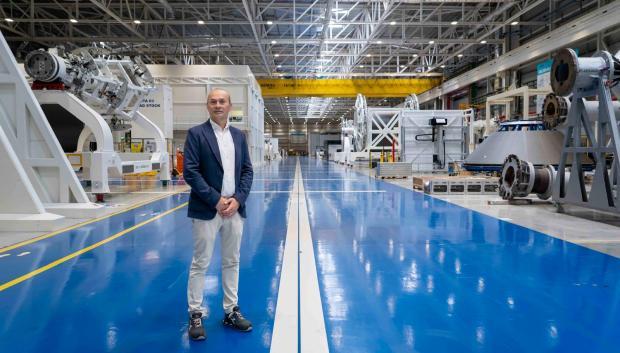
—This Airbus facility was designed in accordance with the leading sustainability standards, including in terms of the materials used. One of our ambitions is to manufacture dispensers capable of collecting some of the space debris that is already orbiting the Earth. Certain designs and projects are being developed with precisely that goal in mind, because the number of launches expected over the coming years is extraordinarily high. We need to think not only about launching spacecraft but also about making room in space by reusing or deorbiting anything that is no longer in service.
What role and milestones would you like Airbus Spain to achieve by the 2030s?
—We are already very well positioned, with a presence in every market and involvement with the world’s leading launchers. What we need to do is continue developing our products and maintaining cutting-edge technology so that we can supply the systems needed to reach the Moon and Mars while providing launchers with increasingly advanced capabilities.
What technical profiles and career opportunities are you currently seeking for programmes such as Ariane?
—Engineering is, of course, the most highly sought-after career path, but we also employ physicists, mathematicians and professionals from all kinds of technical backgrounds. What matters is having the ambition to work in space, regardless of one’s particular technical discipline. It is such an open and fast-growing market that there is room for many different profiles, both highly technical and less technical. Fortunately, more and more universities are promoting technical degree programmes focused on space.
Source: El Debate