
Seville, Spain’s Space Capital, congratulates the European Space Agency and all the teams involved in this new milestone for Earth observation and the European space sector.
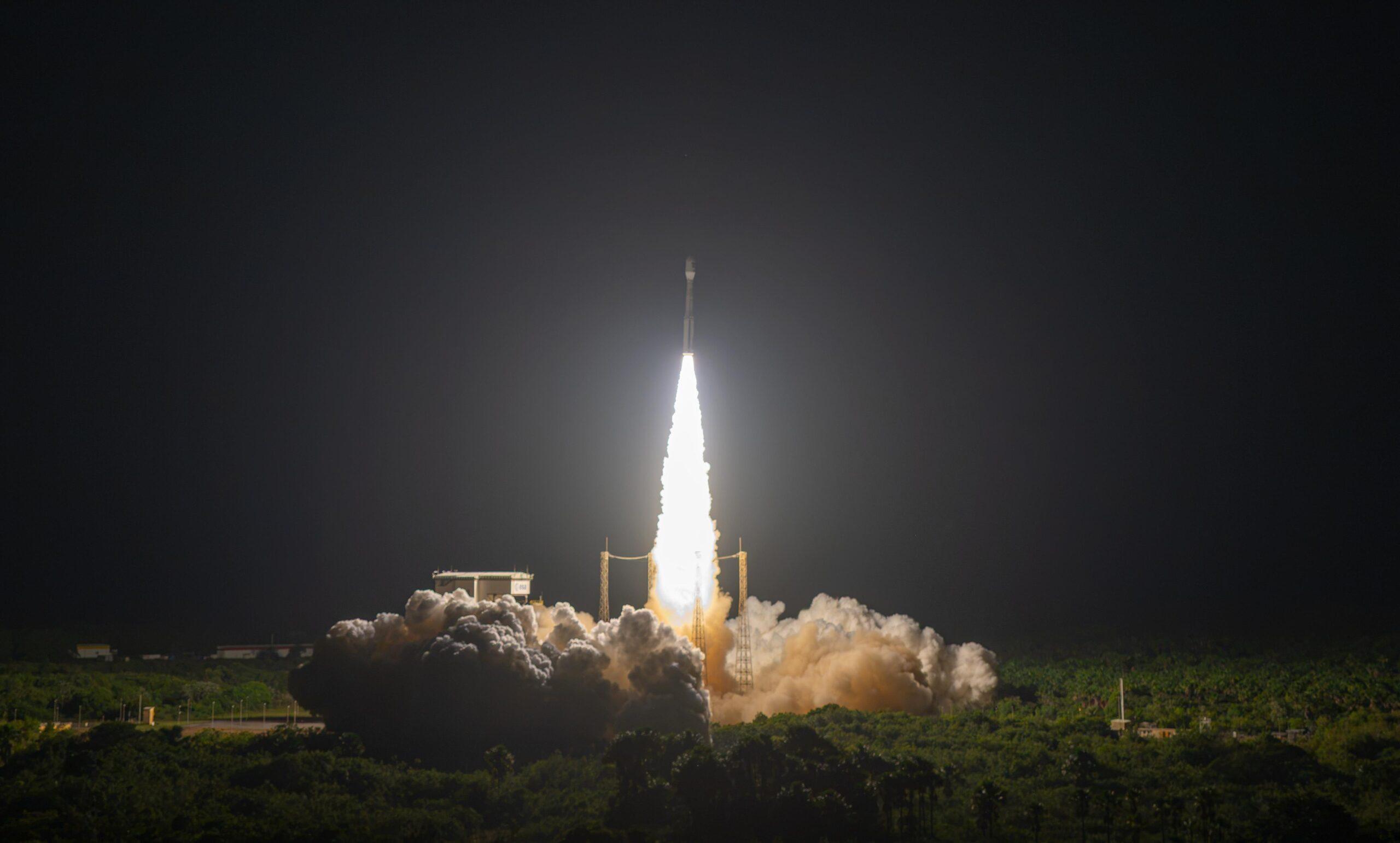
The European Space Agency(ESA) has successfully launched the FLEX Earth Explorer and Copernicus Sentinel-3C satellites aboard a Vega-C rocket from the European Spaceport in French Guiana.
Flight VV30 lifted off on 15 September at 03:21 (CEST). Both satellites were subsequently deployed into their respective orbits, and ESA’s European Space Operations Centre (ESOC) in Germany received the first signals from the two missions, confirming their safe separation from the launch vehicle and the establishment of contact with ground control.
The launch marks a new milestone for European Earth observation programmes and will expand the information available for studying our planet, its ecosystems and the effects of climate change
FLEX: observing photosynthesis from space
FLEX (Fluorescence Explorer) is ESA’s latest Earth Explorer mission and the Agency’s first satellite designed specifically to measure photosynthetic activity from space.
Its main instrument will detect the faint fluorescence emitted by plants as they absorb sunlight during photosynthesis – a signal invisible to the human eye.
The measurements obtained will provide a better understanding of vegetation health and ecosystem productivity, as well as enabling the study of the effects of environmental stress and climate change on plants. The mission will also contribute to a deeper understanding of the carbon and water cycles.
Sentinel-3C bolsters the European Copernicus programme
Copernicus Sentinel-3C, the third satellite in the Sentinel-3 series, has been launched into space alongside FLEX.
The mission will continue to collect essential data on the oceans, the Earth’s surface, ice and the atmosphere. Its instruments will measure, amongst other parameters, land and ocean surface temperatures, ocean colour, ice conditions, vegetation and inland water levels.
This information will support areas such as climate monitoring, ocean forecasting, environmental management and scientific research.
Sentinel-3C forms part of Copernicus, the Earth observation component of the European Union’s Space Programme, developed in collaboration with the ESA.
Another success for European space
This joint launch demonstrates Europe’s ability to develop and launch advanced Earth observation missions that help to expand our knowledge of the planet. Furthermore, the two missions will work in a complementary manner. FLEX’s observations of vegetation fluorescence can be combined with data provided by Sentinel-3, offering the scientific community a particularly comprehensive view of the state and functioning of vegetation on a global scale.
We at Sevilla Capital Espacial Española would like to extend our congratulations to the European Space Agency (ESA) and to all the professionals, institutions and companies that have been involved in the development, preparation and launch of FLEX and Sentinel-3C.
This is yet another achievement in science, engineering and international cooperation that strengthens Europe’s space capabilities and demonstrates, once again, the strategic role of space in helping us to better understand and protect our planet.
Source: https://www.esa.int/Newsroom/Press_Releases/Lanzamiento_de_FLEX_y_Sentinel-3C