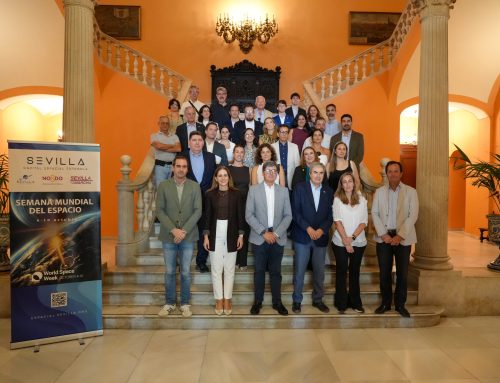

Andalucía Emprende, a foundation attached to the Regional Ministry of Universities, Industry, Energy and Innovation, and the Spanish Space Agency are launching in Seville a new edition of the ‘NASA Space Apps Challenge’, the world’s largest STEAM hackathon, which this year will take place at the Spanish Space Agency’s headquarters on 14 and 15 November.
Organised by NASA and its partner space agencies, with the support of Andalucía Emprende, the event will bring together a diverse range of participants – from students and professionals to creative talents, scientists, technologists and entrepreneurs – to develop innovative solutions that address the challenges set by scientists and technologists from the US agency.
To this end, participants will work in teams over the weekend, using science, technology and open data as a starting point, the Regional Government explained in a press release.
Those interested in taking part can register via the official NASA Space Apps Challenge website and choose from the 14 challenges featured in this edition, which range from space exploration, Earth observation, the search for exoplanets and artificial intelligence to areas such as sustainability, climate research, health and space biology.
In addition, there are challenges focusing on agriculture, robotics, data visualisation and science communication. To tackle these challenges, participants can develop applications, educational tools, technological prototypes, predictive models or creative projects.
With this new edition, Andalucía Emprende and the Spanish Space Agency are reinforcing their commitment to promoting careers in science and technology and their dedication to Seville as a hub for entrepreneurship, open innovation and collaboration amongst STEAM communities.
The winning local team, ‘Dreamcity’, made up of 11- and 14-year-old pupils from San Francisco de Paula School, designed an innovative proposal to envisage and build the sustainable cities of the future, integrating artificial intelligence and ecological planning. The project proposed an urban model based on the efficient use of resources, green mobility and harmony between technological development and human wellbeing. In addition, the ‘FyCUS’ team from the University of Seville was selected as one of the 50 global finalists, with a proposal to revolutionise waste recycling on Mars.
Source: Europa Press