
The project, coordinated by Open Cosmos, also involves the Seville-based companies Integrasys, Alter Technologies, Solar Mems, Andalucía Aerospace and Indaero, as well as the University of Seville, other Andalusian companies and the universities of Cádiz and Vigo.
The mission is dual-use in nature and will cover civilian applications such as border control and the fight against drug trafficking, as well as military intelligence and orbital defence. The launch and deployment into orbit of the satellites, which are currently in the manufacturing and integration phase, is scheduled for 2028.
The satellites developed as part of the programme will incorporate optical sensors specialised in Earth observation. In this field, Integrasys provides advanced processing software capable of analysing the images obtained and automatically characterising objects in real time, identifying and classifying strategic assets such as aeroplanes, helicopters and vessels.
In addition to these capabilities, there is a second technological component designed to capture, process and geolocate electromagnetic emissions from the Earth’s surface. The system is designed to carry out these operations directly on board the satellites, which offers an operational advantage over traditional ground-based processing models. As Álvaro Sánchez, CEO of Integrasys, explained, ‘doing it on board gives you much greater flexibility and allows you to download far less data to the ground’.
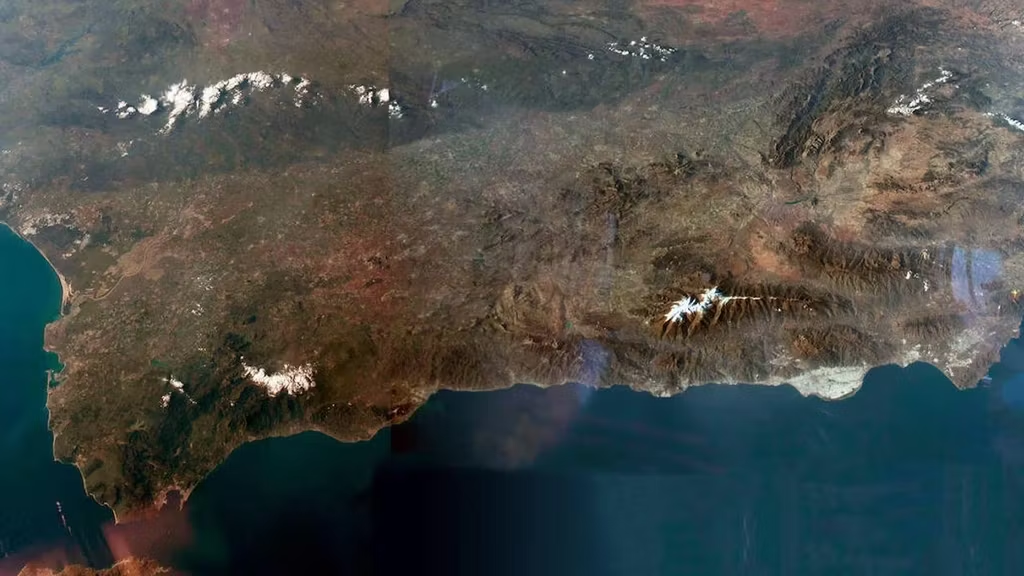
Its applications span both civil security and strictly military contexts. In the areas of surveillance and home affairs, the combination of sensors and electromagnetic analysis will help to monitor unauthorised vessel traffic at maritime borders and track signals linked to drug-trafficking activities in the south of the Iberian Peninsula.
From a military perspective, these capabilities will provide high-value tactical information to the Armed Forces, improving surveillance of areas of interest, the identification of movements and the gathering of intelligence in operational scenarios. Furthermore, the ability to process information directly in orbit will reduce response times and optimise the volume of data that needs to be transmitted to ground stations.
The consolidation of SAETA also provides a boost to Andalusia’s industrial and technological ecosystem. The coordinated involvement of specialist companies in a space programme of this nature reinforces Andalusia’s position as a hub for technological, industrial and defence development, whilst helping to strengthen national capabilities in a sector considered strategic for European autonomy.
Source: El Español