
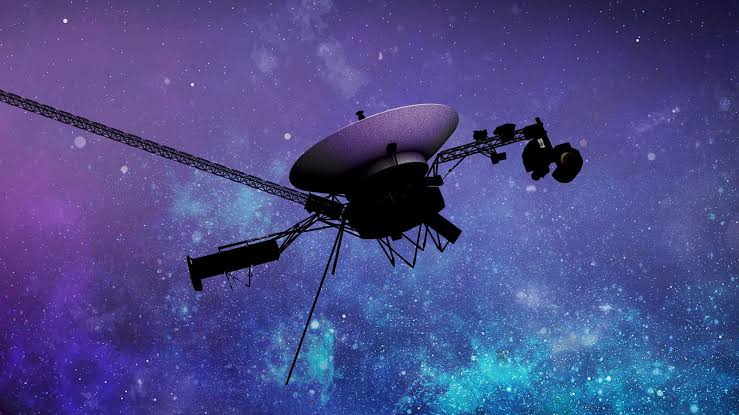
On 18 November, the historic Voyager 1 probe reached a distance of some 25,900 million kilometres from our planet, becoming the first man-made object to reach a distance equivalent to one light-day.
The Voyager 1 space probe, launched by NASA in September 1977, will reach a distance of one light-day from Earth on 8 November, which is equivalent to approximately 25,900 million kilometres.
This milestone will make Voyager 1 the first man-made object to reach such a distance, cementing its place as one of the most extraordinary missions in the history of space exploration.
Almost five decades after its launch, the veteran probe continues its journey through interstellar space, beyond the boundaries of the heliosphere. On board, it carries the famous Golden Record, a symbolic message from humanity intended to convey information about our civilisation to possible extraterrestrial life forms.
However, keeping such a long-running mission operational presents a constant technological challenge. With increasingly limited energy resources and components that have been in operation for almost 50 years, NASA engineers must decide which instruments and systems to keep active, which to switch off, and how to resolve technical issues millions of kilometres away, with no possibility of physical intervention.
Metadev brings the Voyager 1 mission to the public
To mark this new milestone, Metadev, a Seville-based company and member of the Space Forum, has produced two educational resources to bring the fascinating history of Voyager 1 to the public and help people understand the scale of its journey.
Through these materials, anyone will be able to gain a better understanding of the technological challenges of the mission and explore the extraordinary distance this pioneer of space exploration has travelled.
– Informative article: https://blog.apricot.tools/posts/48-hours-to-hear-back/
– Interactive chart: https://blog.apricot.tools/assets/voyager/voyager-1-explorer.html