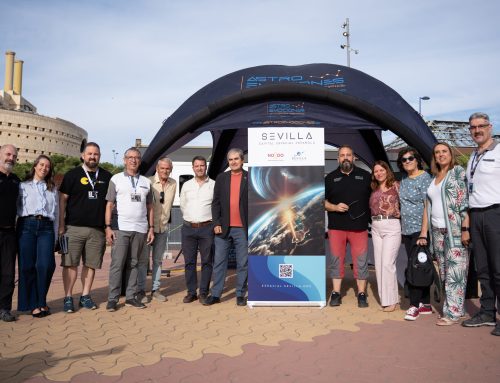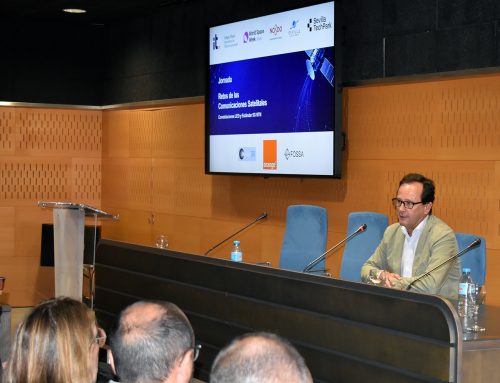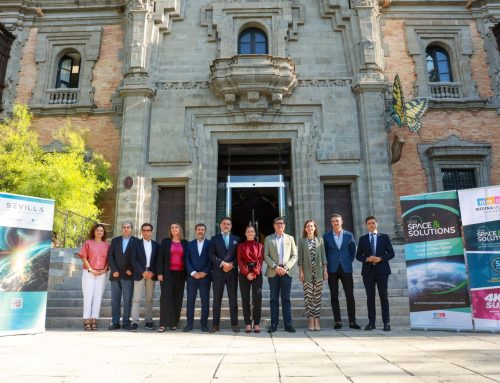

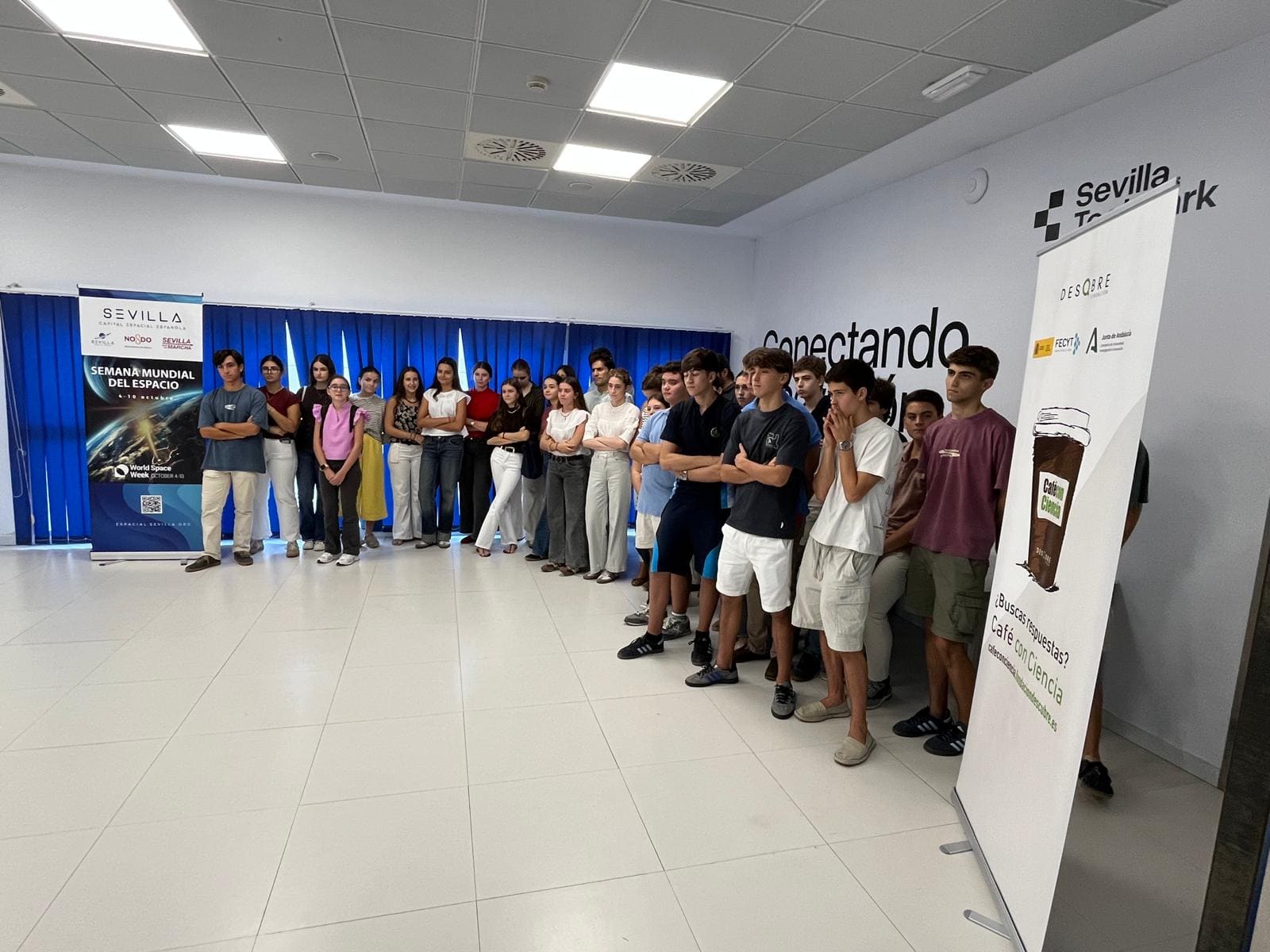
The Descubre Foundation, in collaboration with Sevilla TechPark, has organised two “Coffee with Science” events as part of the programme of activities for Seville World Space Week 2026 (WSW). During these sessions, experts spoke with a small group of students to explain the ins and outs of their day-to-day work, discuss their scientific vocation and research careers, and share insights into their hobbies and life stories. All this took place over breakfast, allowing the conversation with participants to unfold in a relaxed and informal atmosphere, far removed from the traditional speaker-audience format.
In this case, researchers Sergio Esteban Roncero, Ana Sánchez Rivero and Guillermo Pacheco Ramos from the University of Seville, and Luis Merino Cabañas from Pablo de Olavide University, took part in this science outreach event, held once again this year as part of World Space Week.
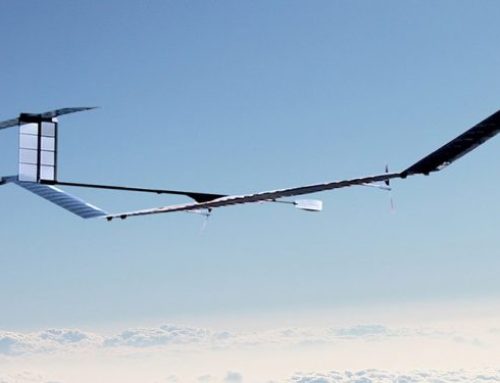
Specifically, during his talk entitled ‘How to become an aerospace engineering researcher by following the advice of great thinkers… and pursuing your dreams’, researcher Sergio Esteban explained to the students what his work involves in the design of unconventional aircraft – that is, aeroplanes and drones that use clean technologies such as hydrogen or electric batteries.
For his part, researcher Guillermo Pacheco spoke to the students about UCAnFly, a satellite built by more than 50 Andalusian students and researchers from various scientific disciplines to conduct scientific research in space, which is scheduled for launch in 2027. Pacheco also discussed with those attending the Café the growing concern over space sustainability and how science is advancing to reduce the pollution generated by the thousands of satellites orbiting the Earth.
Another group of students also discussed space debris with researcher Ana Sánchez Rivero, focusing on satellites, under the title ‘Can satellites collide? How do we prevent collisions in space?’. During this session, Sánchez explained how collision analysis is carried out – in other words, what techniques are used to prevent the many satellites that are now obsolete and no longer functioning, but which continue to orbit the planet, from colliding with one another and generating more contaminating particles and more space debris.
At the same time, robotics expert Luis Merino explained to the students at his session, ‘Flying and space robots: what they can do today and where we’re heading’, the importance and necessity of transferring scientific knowledge to industry. In this regard, he explained in detail how they designed a prototype robot to detect fires. Furthermore, Merino emphasised that these machines are becoming increasingly autonomous and that scientists are working to enable them to repair themselves. “We have been working to track the lava tubes that simulate the Martian landscape, which we can use to map a cave. Bases for Martian exploration could be set up there. This is an example of how advances developed in a cave are sometimes taken into space,” added the UPO researcher.
Source: Descubre Foundation