
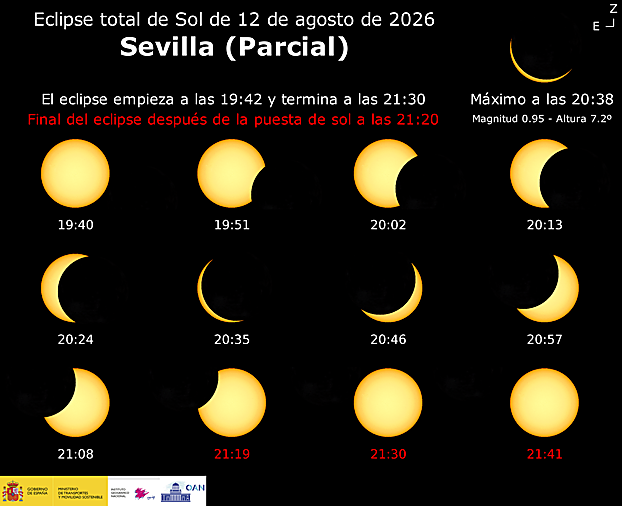
Seville is preparing to experience one of the most significant astronomical events of recent times: the August 12, 2026 eclipse. It will be the first of a trio of eclipses taking place between 2026 and 2028. On this occasion, the phenomenon will be visible as a partial eclipse, although in 2027 it will be possible to observe a total eclipse in parts of Andalusia.
This Wednesday, August 12, the Moon’s shadow will cross the Iberian Peninsula from west to east, making it possible to see a total eclipse across much of the northern half of the country, while in other areas it will be visible as a partial eclipse.
The path of totality will cross the Arctic Ocean, northeastern Greenland and the western tip of Iceland before crossing the Atlantic Ocean and reaching the Iberian Peninsula. It will travel from west to east, passing through numerous provincial capitals, from A Coruña to Palma, including Lugo, Oviedo, León, Zamora, Valladolid, Palencia, Segovia, Burgos, Soria, Santander, Bilbao, Vitoria-Gasteiz, Logroño, Guadalajara, Cuenca, Zaragoza, Teruel, Lleida, Tarragona, València and Castelló de la Plana.
The eclipse will reach its maximum at 7:46 p.m. (official time in mainland Spain and the Balearic Islands) near Iceland, with the maximum duration of totality lasting 2 minutes and 18 seconds.
In Spain, the eclipse will be visible as a total eclipse across much of the northern half of the peninsula, while in the southern half it will be seen as a partial eclipse.
Visibility of this phenomenon will depend not only on being within the path of totality but also on having a clear western horizon, as noted by the National Geographic Institute (IGN) on its website.
Although Seville lies outside the path of totality, the eclipse will also be visible there as a partial eclipse. In the province, the Moon will cover between 94% and 95% of the Sun’s diameter at the eclipse’s maximum, meaning that the sky will not become completely dark, the solar corona will not be visible, and a thin arc of sunlight will remain.
In addition, to enjoy the best views, it is advisable to find an elevated location or somewhere with a completely unobstructed western horizon, since the eclipse will occur shortly before sunset. In this regard, Seville province has several viewpoints and panoramic locations that meet these conditions and from which it will be possible to follow the development of the phenomenon.
The eclipse will last around two hours. It will begin at approximately 7:39 p.m., reach its maximum phase at 8:30 p.m., and end between 9:15 and 9:25 p.m., depending on the observation location.
In Seville province, the eclipse will begin at 7:42 p.m. and reach its maximum at 8:38 p.m., with 93% of the Sun obscured. It will end at 9:30 p.m., although by 9:20 p.m. the Sun will already have set below the horizon.
To make it easier to see how the August 12, 2026 total solar eclipse will appear from the municipalities of Seville, ABC has created an interactive map and a location search tool showing when the eclipse will reach its maximum phase, along with the projected path of the Moon’s shadow and the different visibility zones across the region.
How to View the Eclipse Safely
The Directorate-General for Consumer Affairs of the Andalusian Regional Government’s Department of the Presidency, Health and Emergencies has issued a series of safety recommendations for enjoying the solar eclipse without risk.
As Consumer Affairs has emphasized, experiencing an eclipse is “an unforgettable experience,” but looking directly at the Sun without adequate protection can cause serious and irreversible eye damage, even when it is partially obscured. This damage does not cause any sensation of pain, making it “even more dangerous, as it can go unnoticed,” the agency noted.
It also stated that the Sun must never be viewed directly, either with filters or with the naked eye, or through devices such as binoculars, cameras, glasses, telescopes, or mobile phones.
Conventional sunglasses should not be used, no matter how dark they are. CDs, X-rays, welding glasses or screens, slides, and 3D cinema glasses should also not be used, as none of them has the appropriate filter.
Instead, only special eclipse glasses that comply with the relevant safety standard (ISO 12312-2) should be used. These glasses contain filters that reduce visible light to safe levels and strongly attenuate ultraviolet (UV) and infrared (IR) radiation.
Even these glasses are designed to be used only for periods of less than one minute at a time, with regular breaks. They should only be used if they are in good condition, without any abrasions, punctures, scratches, cracks, or bends. They must also never be used behind the eyepiece of a telescope, since the optics concentrate light and heat.
Source: ABC de Sevilla