
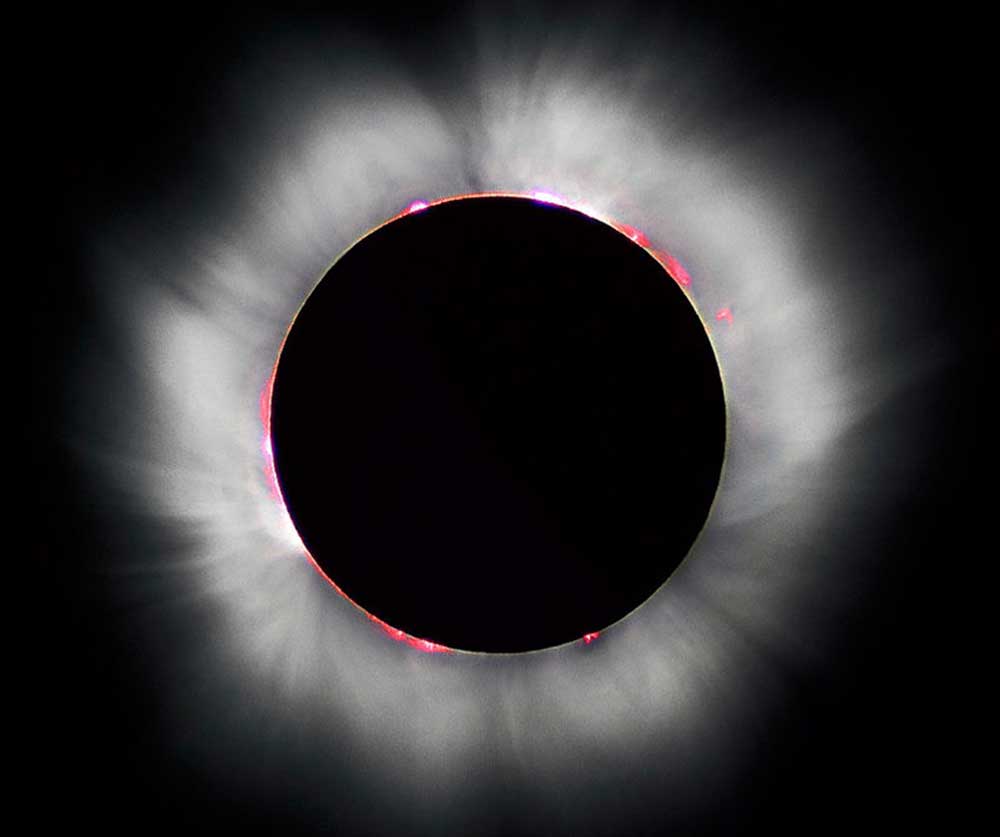
The Andalusian Regional Ministry of Universities, Research and Innovation has established an inter-institutional working group to oversee the general coordination of activities surrounding the total solar eclipses that will take place in 2027 and 2028, in which Andalusia will play a leading role. The 2026 eclipse, meanwhile, will only be partially visible in the region.
The main objective is to provide citizens and visitors with a unique and safe experience, taking advantage of the event as an opportunity to develop scientific, educational, and tourism-related activities, as well as to promote scientific knowledge and innovation in connection with this initiative.
Andalusia will be in an exceptional position to observe the total solar eclipse on August 2, 2027, as the northern half of the eclipse’s path of totality will mainly cross the central and southern areas of the province of Cádiz, as well as the southern parts of Málaga, Granada, and Almería. The town of Algeciras will enjoy the longest duration of totality, while Málaga will experience the shortest.
In addition, the region will once again be a key location for the annular solar eclipse on January 26, 2028, with observation points centered in Huelva, Seville, and western Cádiz. The total solar eclipse on August 12, 2026, will only be partially visible in the region. Solar observation must be carried out using certified eclipse glasses, and even with them, one should not look at the eclipse continuously for more than 30 seconds.
Alongside the University, this working group includes the regional ministries of Health, Presidency and Emergency Services; Tourism and External Affairs of Andalusia; Development, Territorial Articulation and Housing; and Educational Development and Vocational Training. This team will work in coordination with the Interministerial Commission for the Eclipse Trio (CITE), attached to the Spanish Ministry of Science, Innovation and Universities. The Royal Observatory of the Navy (ROA), based in San Fernando (Cádiz), the Calar Alto Observatory (CAHA) in Almería, the Fundación Descubre, the Scientific Culture Unit of the Institute of Astrophysics of Andalusia (IAA-CSIC), based in Granada, and the Seville Space Forum will also participate.
In this way, the program is expected to include simultaneous activities across different locations throughout Andalusia, coordinated by a network of participating entities made up of trustees and technical staff from Fundación Descubre, the Scientific Culture and Innovation Units (UCC+i) of Andalusian universities and research centers linked to astronomy, the Andalusian Association of Astronomy Enthusiasts, as well as companies and organizations from the specialized tourism sector, among others.
Source: Nova Ciencia