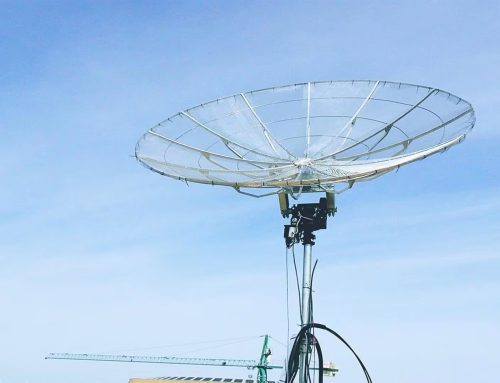

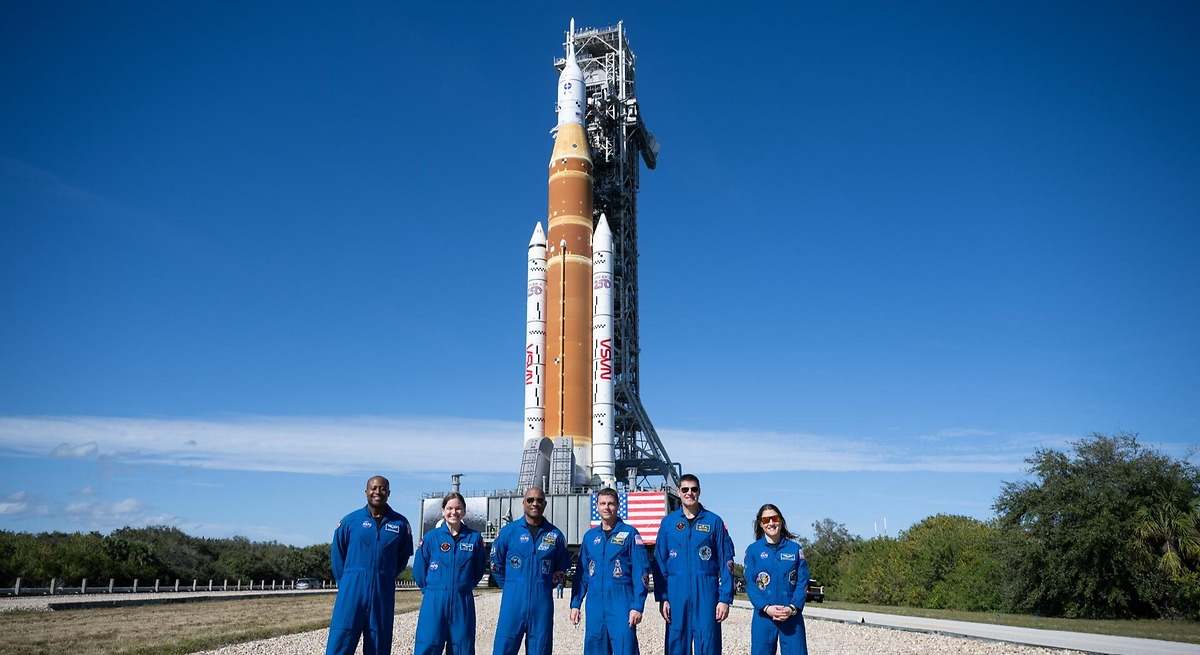
The Spanish company Integrasys has been selected by NASA to monitor the Artemis II mission, which will carry the Orion spacecraft and a crew of four astronauts around the Moon. As a result, the company— the only Spanish participant in this process—will contribute with its own technology and a 2.4-meter-diameter antenna operating in the S-band, installed on the rooftop of the Higher Technical School of Telecommunications Engineering at the University of Seville.
NASA’s Artemis II mission will be the first crewed flight of the Artemis program, sending astronauts aboard the Orion spacecraft around the Moon without landing. Its main objective is to test the spacecraft’s systems and crew safety in a lunar environment before future missions that will reach the surface.
Its significance lies in the fact that it is a key step toward returning to the Moon, demonstrating the capability for human spaceflight beyond Earth’s orbit, and paving the way for sustained exploration and an eventual human presence in deep space. It will also be the first crewed mission launched to the Moon since 1972, when the last lunar landing took place.
According to Integrasys, its “innovative solutions,” recognized in the field of space communications, along with its university-industry collaboration model, were key factors in NASA’s decision. The U.S. space agency selected a total of 34 participants from 14 countries—including companies, academic institutions, and individual amateur radio operators—who are participating voluntarily, without any financial compensation, in the agency’s SCaN (Space Communications and Navigation) program. The program aims to expand and strengthen the ground segment supporting critical space missions. As Integrasys explained to this newspaper, all 34 participants collaborate in tracking the mission; however, since this is carried out from different parts of the world and using different technologies, the information gathered is highly valuable to NASA.
Integrasys will track the spacecraft’s signal and measure the Doppler effect, an essential parameter that makes it possible to determine the vehicle’s position, calculate its trajectory, and provide this data directly to NASA. This will be done during the approximately 10 days the mission is expected to last, while the spacecraft is visible from Spain. The monitoring will be coordinated with other observation points distributed worldwide.
This project is the first one Integrasys has established with NASA, adding to those it has been carrying out for years with the U.S. Space Force and Space Command. According to the company, it represents a “strategic milestone” to strengthen its position in the field of deep space exploration and opens the door to future missions to the Moon, such as Artemis III, and potentially to Mars.
According to Álvaro Sánchez, CEO of Integrasys, the project fulfills a dual objective. On the one hand, it strengthens the company’s position in the deep space exploration market, a sector expected to experience significant growth in the coming years. On the other hand, it helps place Spain at the forefront of satellite communications.
Source: El Economista