
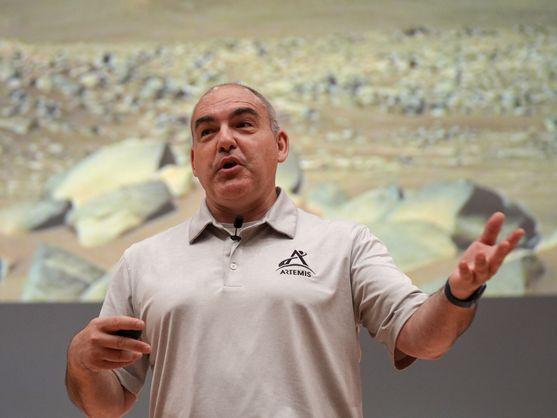
Carlos García-Galán, an engineer from Málaga with a long career at NASA, has become one of the key figures in the agency’s new lunar project. His appointment as program executive of the future base, which is expected to be fully operational by 2032 if all goes according to plan, places him at the center of a project aimed at transforming humanity’s presence beyond Earth.
Before taking on this new role, García-Galán served as deputy director of the Gateway program, a crucial part of the lunar plan that has now been indefinitely canceled. He had also held prominent positions related to the European Service Module, the system that provides water, oxygen, and power to the Orion spacecraft, which is set to carry the next generation of astronauts under the Artemis program.
His professional career spans more than two decades within NASA and over 27 years of experience in crewed spaceflight. During this time, he has worked on the design, integration, and operation of complex systems, in addition to participating in programs linked to the International Space Station and NASA’s lunar strategy.
This experience aligns with NASA’s new direction, which aims to move beyond purely experimental missions toward a stable human presence on the lunar surface. García-Galán himself has previously expressed this vision in interviews, explaining that the Moon should serve as a testing ground before the next major leap to Mars, where technical and logistical challenges will be even greater.
The program he now oversees will be carried out in three phases. The first phase (2026–2028) aims to ensure more reliable access to the Moon through increased cargo and landing missions, along with new technologies to enhance crew safety. The second phase (2029–2031) will begin the construction of the base, including communication, navigation, and power infrastructure.
From 2032 onwards, the third phase will focus on sustaining longer-term human exploration on the lunar surface. In this context, García-Galán summarized the project’s ambition with a statement reflecting the scale of the challenge:
“From today, we are building humanity’s first outpost in deep space.”
Source: El Confidencial